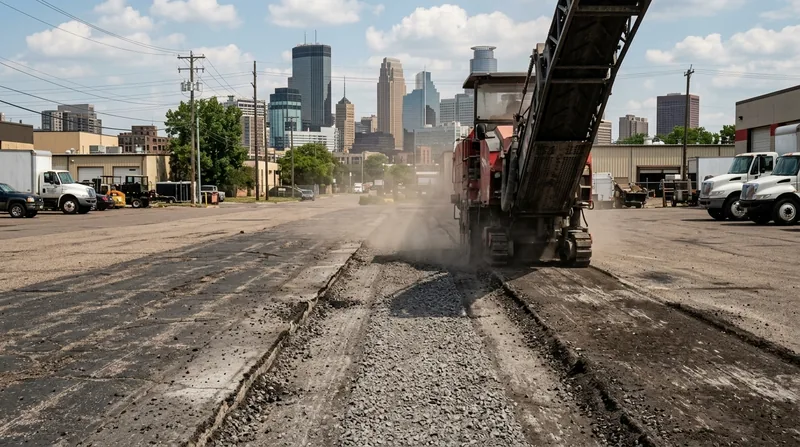




Asphalt Milling & Removal in Minneapolis is the first step when a driveway or parking lot is too damaged to patch or overlay. The Twin Cities sit on glacial till and clay that moves with the freeze-thaw cycle, and after 15 to 20 years of Minnesota winters, the base layer often fails beneath a surface that looks repairable from above. When alligator cracking runs deep, when an overlay would simply bridge air, or when you're rebuilding a parking lot from the ground up, we grind out the failed asphalt down to sound material, haul away the millings, and leave a clean, compacted grade ready for new base and surface course. This is the honest move before a full-depth replacement, and it costs less than tearing out and starting over from raw dirt.
Why Asphalt Milling Matters in the Minneapolis Climate
Minneapolis driveways and parking lots fail in patterns. The spring thaw opens potholes and surface cracks; heavy plowing scars edges at the street line; and the freeze-thaw cycle that runs 42 inches deep in Hennepin and Ramsey counties works the asphalt until the binder breaks and the stone separates. By the time you see alligator cracking across thirty to forty percent of the surface, the base layer has lost its bond. A new overlay will not hold. Milling removes the failed surface and any weak material below it, so the new course sits on a solid foundation instead of bridging failure.
- Frost heave and spring thaw create subsurface voids that cause alligator cracking and surface collapse.
- Milling eliminates the failed layer and restores proper drainage pitch to the grade beneath.
- The milled surface is compacted and proof-rolled before new asphalt is laid, ensuring the new course will not settle.
- Recycled millings can be reused as base material, reducing the volume of new aggregate needed on site.
Getting to solid ground is the only way to build a driveway or parking lot that will last through the next decade of Minnesota winters.
Key info: A driveway in Brooklyn Park or Maple Grove that shows alligator cracking over thirty to forty percent of the surface is a candidate for milling and overlay, not patching. Once the base fails, every repair throws money away. Milling costs more upfront but saves you from repeated repairs over the next three to five years.
How We Mill and Remove Asphalt in Minneapolis
Milling is a controlled grinding operation that removes asphalt to a depth you specify, based on what the pavement needs. We arrive with a milling machine that grinds the surface and collects the material into a truck; the grade is left clean, compacted, and ready for new asphalt or for a temporary gravel surface if you need to wait for spring. The whole process is dusty but contained, and the site is left broom-clean.
- We measure the driveway or parking lot and assess the depth of failure with a probe or core sample.
- We mobilize the milling machine and grinding truck to your site, typically early morning to minimize disruption.
- We grind the asphalt to the depth required, usually one to two inches for a resurfacing or two to four inches for a full-depth job.
- The milled material is collected in the truck; we can recycle it as base material or haul it away for processing.
- The exposed grade is compacted with a vibratory roller and proof-rolled to verify it will support new asphalt.
- We sweep and blow the surface clean, leaving a ready-to-pave grade.
The entire operation typically takes one to two days for a residential driveway and up to a week for a large parking lot, depending on size and the depth of material removed.
Example: A parking lot in Bloomington with two inches of alligator cracking can be milled to remove the failed surface and one inch of base. The milled material, about 40 to 50 tons, is hauled away or recycled. The grade is compacted and proof-rolled. New two-inch binder and surface course are laid the next day. Total time: two days. Total cost: less than full removal and replacement.
For more on what comes after milling, see our Asphalt Resurfacing & Overlay page.
Milling Methods and When to Use Each
| Approach | Description | Best for |
|---|---|---|
| Shallow milling (1-1.5 inches) | Remove the surface course only, leaving the base intact if it is sound. | Driveways with surface-only cracking or weathering, no subsurface failure. |
| Medium milling (2-3 inches) | Remove surface and top portion of base to reach sound material below. | Alligator cracking, rutting, and early-stage base failure in parking lots and driveways. |
| Full-depth removal (4+ inches) | Remove all asphalt and damaged base down to subgrade or sound material. | Complete base failure, water intrusion, or when the site requires a fresh base build-up. |
| Selective milling | Mill only the failed sections of a parking lot or driveway, leaving sound areas intact. | Parking lots with isolated patches of alligator cracking or areas of heavy traffic wear. |
The depth is determined on site by visual inspection and sometimes a core sample. We always recommend the shallowest depth that removes all failed material, because shallower milling is faster and less costly.
Asphalt Milling & Removal Cost in Minneapolis: What to Expect
Milling cost depends on the depth, the total area, site access, and whether the millings are recycled or hauled away. A typical residential driveway milling runs from $1,500 to $3,500, depending on size and depth. A parking lot is priced by the square foot and the tonnage of material removed, typically ranging from $0.50 to $1.50 per square foot for shallow to medium milling. Full-depth removal with base prep can run higher, and jobs with limited access or tight site conditions cost more because the milling machine cannot work efficiently.
The single biggest factor in your quote is the depth of material to be removed. One inch of asphalt over 2,000 square feet of parking lot is roughly 35 to 40 tons; two inches is 70 to 80 tons. Hauling costs money. Recycling the millings on site as base material for a new overlay saves on removal and new aggregate, which is why we always ask whether the material can stay on the property.
The best way to know your cost is to get a written estimate that includes the depth, the total tonnage, and whether the millings are included in the price or hauled separately. We provide tonnage specs on every estimate, so you know exactly what you are paying for.
For detailed pricing on related services, see our full pricing overview.
What to Look for When Hiring an Asphalt Paving Contractor Near Me in Minneapolis
Milling is a specialized operation that requires the right equipment and site knowledge. When you call a contractor, ask for a written estimate that includes the milling depth in inches, the total tonnage of material to be removed, and whether disposal or recycling is included in the price. A contractor who can give you those numbers knows the work. A contractor who quotes a price per square foot without measuring or specifying depth is guessing.
- Ask for a site visit and a written estimate that specifies milling depth and tonnage.
- Verify that the contractor carries full insurance and can show you a current certificate on request.
- Ask whether any local permits are required for the work; in Minneapolis and surrounding cities, milling in the right-of-way or near utilities may need a permit.
- Check references from recent jobs in your neighborhood; word-of-mouth from a nearby property owner is the strongest signal.
- Confirm the timeline and whether the contractor can schedule your job within your window.
- If your property is governed by an HOA, verify that milling and the subsequent resurfacing meet architectural standards before you commit.
We have been in business in Minneapolis since 2010 and are fully insured. Call us at (952) 206-5214 for a free estimate with written tonnage specs. We respond within 24 hours and never push you toward a job you do not need.
Asphalt Milling & Removal in Minneapolis: Pricing Guide
| Service | Price | Details |
|---|---|---|
| Shallow milling (1-1.5 inches) | Starting at $1,500 | Residential driveway surface removal, 1,500 to 2,500 square feet, includes compaction and broom clean |
| Medium milling (2-3 inches) | Starting at $2,500 | Driveway or small parking lot, includes base material removal and proof rolling to grade |
| Parking lot milling | From $0.75 per sq ft | Large-area milling, typically 5,000 to 20,000 square feet, material hauling included or recycled on site |
| Full-depth removal with base prep | On estimate | Requires site inspection to assess subgrade condition, drainage, and preparation depth before pricing |
| Material disposal | Included or negotiated | Milled asphalt can be recycled as base material, reducing cost, or hauled away if site does not permit storage |
| Estimate | Free | Written estimate with tonnage specs, response within 24 hours, no obligation, call (952) 206-5214 |
Indicative pricing, the exact cost depends on square footage, finish, and site access. Free personalized estimate within 24h at (952) 206-5214.


