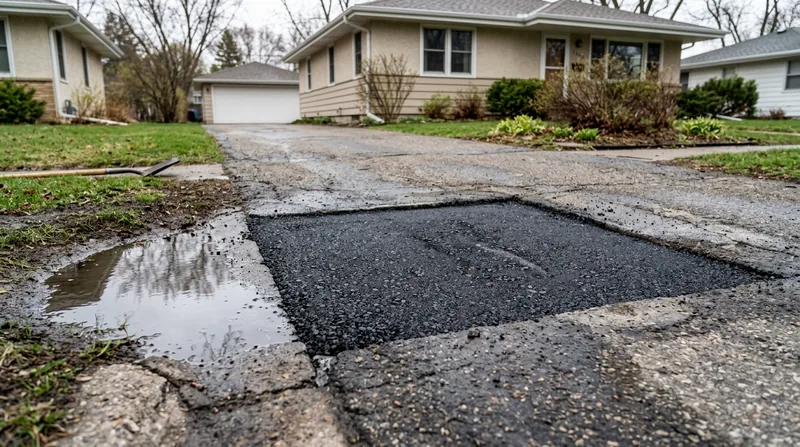




Minneapolis springs bring the deep thaw, and with it comes the potholes. When frost pushes out of the glacial till at 42 inches deep, the asphalt on top cracks and caves. A pothole repair and asphalt patching job done right stops the damage from spreading and buys you time before a full resurfacing or replacement becomes necessary. We saw-cut a clean edge, tack the joint, and pack a full-depth patch so it holds through the next freeze-thaw cycle. Our work covers residential driveways across Minneapolis and the surrounding Twin Cities, from tight side drives in the pre-war bungalow neighborhoods to the wider lots of the post-war rambler ring where the original asphalt is reaching end of life all at once. A pothole left unrepaired grows fast, pulling base material with each thaw and every truck that crosses it. We stop that deterioration before it reaches the point where patching throws money away.
Why Pothole Repair Matters in Minneapolis: Spring Thaw and the Deep Freeze Cycle
Minneapolis sits on glacial till and clay that holds water and gives it up slowly. Frost runs 42 inches deep here, deeper under an uninsulated slab, and the spring thaw that follows is hard enough that the state posts load limits on roads until the frost is out. A long winter of freeze-thaw crossings and heavy plowing scars edges and aprons at the street line, and the spring thaw opens potholes fast. The damage spreads quickly because the base material underneath is already compromised by water and movement. Ignoring a pothole for even a few weeks can turn a $500 repair into a $3,000 resurfacing job.
- A pothole expands each time the base material freezes, thaws, and settles under traffic.
- Water pooling in the hole accelerates erosion of the subbase and surrounding asphalt.
- Plowing equipment and salt trucks deepen the hole and pull material from the edges.
- Patching early in the spring, before the hole reaches the base, holds through the next winter.
- Extensive potholing across a driveway signals that the base has failed and resurfacing is the better investment.
Catching potholes in April or May, before summer traffic and heat harden the damage into a permanent weak spot, is the smart move.
Key info: Minneapolis homeowners often see 3 to 5 potholes open up in April and May on driveways that survived the winter intact. The frost pushes out, water drains, and the asphalt settles unevenly. A single patch costs far less than a full resurfacing, but only if you call while the hole is still small and the base is still sound. For a free assessment of your driveway, call (952) 206-5214.
For more context on spring maintenance, see our guide to driveway repair in Minneapolis.
How We Repair Potholes and Patch Asphalt in Minneapolis
We saw-cut a clean perimeter around the damaged area so the new patch has a solid edge and won't shear off under traffic. The cut removes the ragged, broken asphalt and gives us a clean line to work from. We then clean out all the debris and loose base material, tack the joint with a sticky bonding agent, and pack in a full-depth patch of hot mix asphalt. The patch compacts and cures as it cools, locking into place. On a single pothole or a handful of isolated patches, this method holds for years. If the damage is spread across 30 to 40 percent or more of the driveway, or if we see extensive alligator cracking, we recommend resurfacing or replacement instead, because patching at that scale throws money away.
- We assess the pothole and the surrounding asphalt to determine if a patch will hold or if resurfacing is the better choice.
- We saw-cut a clean edge around the damaged area so the patch has a solid perimeter.
- We remove all loose material and debris, and inspect the base for water damage or erosion.
- We tack the joint with bonding agent and pack a full-depth patch of hot mix asphalt.
- We compact the patch and allow it to cool and cure before the driveway returns to service.
The entire job typically takes a few hours for one to three potholes, depending on size and access.
Example: A homeowner in south Minneapolis noticed a pothole opening in her driveway in mid-April. It was about 18 inches across and 4 inches deep, with clean edges and no cracking around it. We patched it with a full-depth repair, and two years later it is still holding. The base underneath was sound, so the patch took. Had she waited until July, when the hole had grown to 3 feet across with alligator cracking radiating from it, the base would have been compromised and a patch would not have held.
Learn more about when to patch versus when to resurface by reviewing our asphalt resurfacing and overlay service.
| Approach | Description | Best for |
|---|---|---|
| Full-depth patch | Saw-cut clean edge, remove all loose material, tack joint, pack hot mix asphalt, compact and cure. | One to three isolated potholes with sound base underneath; holds for 3 to 5 years on a well-maintained driveway. |
| Skin patch | Quick surface fill without saw-cut or full depth; bonds to existing asphalt and fills the hole. | Temporary repair on a driveway already slated for resurfacing; not recommended as a permanent fix. |
| Multiple patches plus resurfacing | Patch isolated potholes now, then resurface the entire driveway in the next season to unify the surface. | Driveway with scattered potholes and moderate cracking; extends life 10 to 15 years at lower cost than full replacement. |
| Full-depth replacement | Remove all asphalt and base, mill if needed, regrade, lay new base and new asphalt surface, compact and cure. | Driveway with 40 percent or more surface failure, alligator cracking, or base failure; provides 15 to 20 year service life. |
Pothole Repair and Asphalt Patching Cost in Minneapolis: What to Expect
A full-depth pothole patch in Minneapolis typically starts at $450 and moves up based on the size of the hole, the condition of the base underneath, and how many potholes need repair on the same visit. A single 18-inch pothole with a sound base runs around $450 to $600. If we find that the base is eroded or if the hole is larger than 2 feet across, the cost rises. Three to five potholes on the same driveway, patched in one visit, average $800 to $1,200 because we are already mobilized and can work efficiently. If your driveway has extensive potholes spread across more than 30 percent of the surface, or if we see alligator cracking and base failure, resurfacing becomes the better value, typically running $2.50 to $3.50 per square foot depending on the driveway size and condition.
The cost of a patch depends on four main factors. First is the size of the pothole itself, because a larger hole requires more material and more labor to remove debris and compact the patch. Second is the condition of the base underneath, because if the base is eroded or soft, we may need to add gravel or stabilize the subgrade before we can pack the patch, which adds cost and time. Third is the number of potholes on the same driveway, because multiple potholes on one job reduce the per-patch cost through efficiency. Fourth is access, because a tight side drive in a Minneapolis bungalow neighborhood may limit our equipment and add hand work, which increases labor.
We always recommend getting 2 or 3 estimates from different contractors so you can compare approach, materials, and price. A written estimate should include the size or tonnage of material, the method (full-depth or skin patch), the timeline, and any warranty on the work. For a free estimate with no obligation, call us at (952) 206-5214 or visit our pricing overview for more detail on costs across all our services.
Pothole Repair and Asphalt Patching Near Me: What Minneapolis Homeowners Should Know When Hiring
The strongest trust signal in driveway paving is being verifiably local, because the historic fraud in this trade is the itinerant door-to-door crew with out-of-state plates offering to use leftover asphalt from a nearby job. An honest contractor will show up with a local address, local phone number, and a truck with local plates. They will measure your driveway, give you a written estimate with tonnage or square footage, and answer questions about why they recommend one method over another. They will explain what holds and what does not, and they will propose repair or resurfacing before replacement whenever the driveway justifies it.
When you call a contractor for a pothole repair estimate, ask these questions. First, do they have full insurance coverage and can they provide a certificate. Second, will they give you a written estimate with the size of the patch, the material tonnage or quantity, and the method they plan to use. Third, what is their warranty on the patch itself, and is it workmanship only or does it include the material. Fourth, do they handle any permitting if your driveway apron or extension requires a city permit. Fifth, if your property is in an HOA community, do they understand HOA architectural standards and can they work within them. Sixth, ask for references from homeowners in your neighborhood, because paving work is visible and a neighbor's experience is worth more than any marketing claim.
- Verify that any contractor you hire carries full insurance and can provide a current certificate of coverage.
- Get a written estimate that includes the size of the patch, material tonnage, method, and timeline.
- Ask for a workmanship warranty of one to three years on the patch, and understand what it covers.
- If your driveway apron or extension will be repaved, confirm that the contractor understands local permitting and will help you navigate it.
- If you live in an HOA community, verify that the contractor understands the architectural standards and has experience working within them.
- Ask for references from other homeowners in your area, and call them to ask about the quality of the work and whether the contractor showed up on time.
Red flags to watch for include a contractor who shows up unsolicited at your door, offers a price that seems too good to be true, asks for a large cash deposit before starting work, does not provide a written contract, or refuses to give you references. These are the hallmarks of the traveling paving scam. An honest contractor will be happy to answer your questions, provide a written estimate, and let you verify their insurance and track record before you commit.
For a free, no-obligation estimate from a Minneapolis paving contractor with 14 years in the trade, contact us online or call (952) 206-5214. We measure on site, provide written estimates, and explain our recommendations in plain language.
Pothole Repair & Asphalt Patching in Minneapolis: Pricing Guide
| Service | Price | Details |
|---|---|---|
| Single pothole patch (up to 2 feet across) | Starting at $450 | Full-depth patch with saw-cut edge, material, labor, and compaction; larger holes or soft base cost more |
| Three to five potholes, same driveway | Starting at $800 | Multiple patches in one visit reduce per-patch cost through efficiency; total depends on size and base condition |
| Extensive potholing or alligator cracking (30 percent-plus surface failure) | On estimate | Resurfacing or replacement is the better value; requires site assessment to determine scope and material needs |
| Estimate | Free | On-site measurement and written estimate with no obligation; response within 24 hours at (952) 206-5214 |
Indicative pricing, the exact cost depends on square footage, finish, and site access. Free personalized estimate within 24h at (952) 206-5214.


