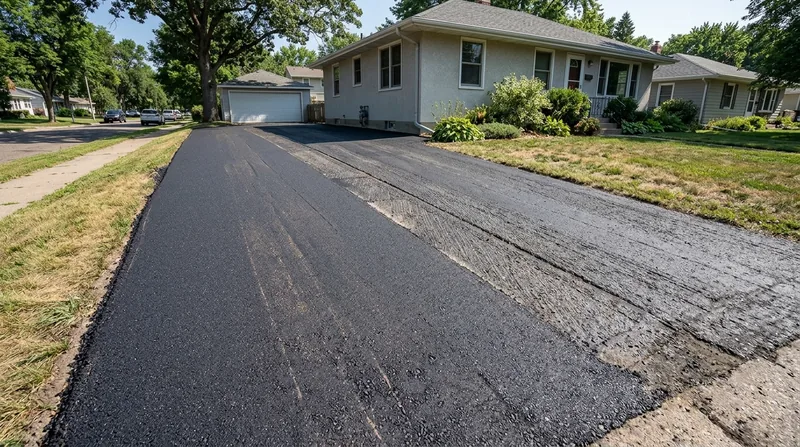




Asphalt resurfacing and overlay in Minneapolis restores driveways worn thin by decades of plowing, freeze-thaw cycles, and the hard spring thaw that follows. The glacial till and clay base that underlies most Twin Cities properties holds water through the freeze, and when the frost releases, the surface cracks and settles unevenly. A milled resurface removes the damaged top layer, ties in fresh binder and surface course, and pitches the crown to shed water instead of holding it against a weakened base. For driveways that have not yet failed completely, resurfacing is the honest choice. It costs less than replacement, extends the life of the structure, and avoids the permit and utility-locate work that full-depth removal requires.
Why Asphalt Resurfacing Matters in Minneapolis: The Freeze-Thaw Reality
Minneapolis driveways built in the 1950s through 1980s now carry surface wear that runs deep. Forty-two inches of frost penetrates under an uninsulated slab each winter, and the spring thaw opens the pavement from underneath while plows scarred the edges for decades. A thin, crazing surface cannot be patched effectively once it covers more than thirty to forty percent of the driveway. At that point, resurfacing is the move that saves money and adds years to the base.
- Milling removes the weakened top course without disturbing the base structure.
- Fresh binder and surface course bond to the prepared substrate and cure for six to twelve months before any sealcoat.
- Proper crown and pitch move water away from the slab, reducing the freeze-thaw damage cycle.
- Resurfacing costs thirty to fifty percent less than full-depth replacement in most Minneapolis properties.
A resurfaced driveway in good condition can add ten to fifteen years of service life if the base remains sound. The key is catching the failure before the alligator cracking runs so deep that the base itself moves with the season.
Key info: Minneapolis building code requires permits for driveway aprons and curb cuts at the street line. Verify with your city or village before scheduling work, as requirements vary across Hennepin County and the surrounding metro area. Contact us and we help navigate the permitting process with your municipality.
How Asphalt Resurfacing Works: The Minneapolis Method
We begin with a site visit to measure the driveway, assess the base condition, and identify drainage and edge concerns. A probe or core sample confirms whether the base is sound enough for an overlay, or whether full-depth replacement is necessary. Once we confirm that resurfacing is the right call, we schedule the work during the paving season, typically mid-April through mid-November when ambient temperature and mix design allow proper compaction and curing.
- We mill the existing surface to the depth specified by the estimate, typically one to one-and-a-half inches.
- The milled material is removed from site or recycled into the new base course if it meets density and compaction requirements.
- We proof-roll the prepared surface to confirm stability and identify soft spots that require additional base work.
- Hot mix binder course is laid and compacted, followed by the surface course, which is finished to proper crown and pitch.
- The new surface cures for six to twelve months before any sealcoat application.
A Minneapolis driveway in Edina or St. Paul that shows crazing and minor edge breaks but holds a solid base under a probe is an ideal candidate for this approach. We document thickness and tonnage on every estimate so you know exactly what is being applied.
Real example: A 1970s rambler in Bloomington with a 400-square-foot driveway and a solid gravel base showed crazing across sixty percent of the surface. Rather than remove and replace the entire slab, we milled one-and-a-quarter inches, laid fresh binder and surface, and restored the crown. Total cost was roughly half a replacement bid. That same driveway will serve another twelve to fifteen years if water management holds.
Resurfacing Methods and When Each One Works
| Approach | Description | Best For |
|---|---|---|
| Mill and Overlay | Remove one to one-and-a-half inches of surface, proof-roll the base, lay fresh binder and surface course. | Sound bases with crazing, alligator cracking under forty percent, and edge wear. |
| Thin Overlay | One-half to three-quarter inch of new surface laid directly over the existing pavement after a tack coat. | Driveways with minor wear, good drainage, and no structural movement. |
| Full-Depth Replacement | Remove the entire slab to subgrade, rebuild the base, and install new asphalt from bottom to top. | Bases that move seasonally, alligator cracking over forty percent, and extensive edge failure. |
| Recycled Milling Overlay | Mill the surface and incorporate the reclaimed asphalt into the new base course, reducing virgin material cost. | Budget-conscious work on sound bases where material recovery meets local environmental goals. |
The choice between these approaches hinges on the base condition. A milling and removal assessment tells us whether the soil is stable or whether the frost-heave pattern suggests the base has begun to fail. If the base is sound, resurfacing saves money and time. If the base is moving, resurfacing will fail within a few seasons, and replacement is the honest call.
Asphalt Resurfacing and Overlay Cost in Minneapolis: What to Expect
Asphalt resurfacing in the Minneapolis area runs from approximately four dollars per square foot for a straightforward mill-and-overlay on a sound base with good access. A typical 400-square-foot driveway in that condition costs between 1,600 and 2,000 dollars. Factors that move the price include base condition, milling depth, edge and apron work, slope and drainage modification, and whether the site requires additional grading or fill.
A property with a tight side drive, poor drainage, or a base that requires repair before resurfacing will cost more. A larger lot or parking area will cost less per square foot due to efficiency. Getting two or three written estimates that include thickness, tonnage, and milling depth is the standard practice. That transparency is what separates honest quotes from door-to-door pricing that changes once the job starts.
For a detailed breakdown of what factors move the cost and how we structure estimates, visit our pricing overview. We provide written estimates with tonnage and thickness specifications so there is no confusion about what the price covers.
Asphalt Resurfacing and Overlay Near Me: What Minneapolis Homeowners Should Know When Hiring a Contractor
Minnesota does not require a state contractor license for single-skill asphalt paving operations, and permitting is handled at the city or village level. That means your responsibility is to verify that any contractor you hire is fully insured, provides a written contract with thickness and tonnage details, and understands local permitting requirements for your specific property.
- Ask for a written estimate that specifies milling depth, binder and surface course thickness in inches, and total tonnage of material.
- Verify that your city or village requires a permit for driveway aprons or curb cuts, and confirm the contractor will help you navigate that process.
- Check references from properties in Minneapolis, St. Paul, Bloomington, or nearby suburbs completed in the last two to three years.
- Be cautious of unsolicited door-to-door offers, large cash deposits, out-of-state equipment, or pricing that seems too low to be honest.
- If your property is in an HOA community, verify architectural standards before booking, as some master-planned communities restrict asphalt to specific colors or require board approval.
A local contractor with a local address and local equipment is the strongest signal of reliability in this trade. The itinerant "leftover asphalt from a job nearby" pitch is the historic marker of paving fraud. An honest contractor will explain the condition of your base, propose repair or resurfacing before replacement, and put the details in writing. Call us at (952) 206-5214 for a free estimate with no obligation. We respond within 24 hours and provide detailed, written quotes on every job.
Asphalt Resurfacing & Overlay in Minneapolis: Pricing Guide
| Service | Price | Details |
|---|---|---|
| Mill and Overlay, standard depth | Starting at $4/sq ft | One to one-and-a-half inch mill with fresh binder and surface course on sound base with good access |
| Thin overlay without milling | Starting at $2.50/sq ft | Half to three-quarter inch new surface on existing pavement where base is stable and drainage is adequate |
| Full-depth replacement | Starting at $6/sq ft | Complete removal, base rebuild, and new installation from subgrade up on failed or moving bases |
| Recycled milling base course | Starting at $3.50/sq ft | Mill and incorporate reclaimed asphalt into new base, reducing virgin material cost on sound structural bases |
| Apron, edge, or drainage work | On estimate | Curb cuts, street aprons, and grading require site assessment and municipal permit verification before pricing |
| Free written estimate | No obligation | Response within 24 hours at (952) 206-5214, includes thickness, tonnage, and all detail specifications |
Indicative pricing, the exact cost depends on square footage, finish, and site access. Free personalized estimate within 24h at (952) 206-5214.


