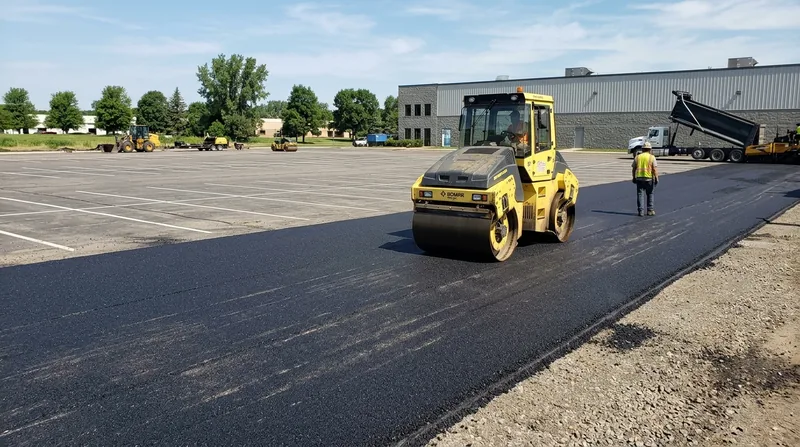




Parking Lot Paving & Construction in Minneapolis demands a full-depth base built to handle Minnesota winters. Commercial lots in the Twin Cities take a beating from four months of plowing, salt, and freeze-thaw cycles that crack and heave cheaper installations. The glacial till and clay under Minneapolis hold water through the spring thaw, so a parking lot paved on an unprepared base moves with the season instead of the traffic. We build a structural base rated for load limits, then pave binder and surface courses pitched to drain across flat Twin Cities ground, so water runs off instead of pooling and working into the base. A lot built this way holds up through decades of Minnesota winters instead of failing in five.
Why Parking Lot Paving & Construction Matters in Minneapolis Winter
Minneapolis parking lots fail from the ground up. The frost runs 42 inches deep, and the spring thaw opens potholes and alligator cracking in lots built on thin bases or no base at all. A lot that looks solid in July can be a map of cracks by April, and by then the base has absorbed water and is failing underneath. Full-depth construction prevents that collapse by installing a structural base that sheds water instead of holding it. The cost of getting the base right the first time is far less than the cost of patching a failed lot for the next ten years.
- Winter plowing and salt damage the edges and surface of thin lots, opening cracks that let water into the base.
- Freeze-thaw cycling heaves asphalt and breaks bond between layers when the base is not properly prepared or drained.
- Flat Twin Cities terrain means water drains from pitch, not grade, so surface crowning and proper slope are critical to keeping the base dry.
- A full-depth base with proper compaction and drainage keeps water out, which keeps the lot intact through the spring thaw.
Getting the base right is what separates a parking lot that lasts twenty years from one that fails in five.
Key info: Minneapolis posts load limits on roads every spring until the frost is out of the ground. A parking lot built with a thin base or no base cannot carry the weight of loaded trucks and service vehicles during that thaw window, and it fails fast. A proper full-depth base is rated for those loads year-round.
For more on what happens when the base fails, see our guide to Parking Lot Repair & Resurfacing in Minneapolis.
Minnesota does not require a state contractor license from a business that works in only one special skill, and asphalt paving is exactly one such skill. Permits for parking lot work, aprons, and curb cuts are set by the municipality and vary from city to city, and we help you navigate those requirements with your local building department. You can verify permitting rules for your lot with the city or village where it sits. For more detail, check your local Minneapolis building department.
How We Build a Parking Lot in Minneapolis: The Full-Depth Process
A parking lot that holds up through Minnesota winters starts with site work. We grade the lot to shed water, haul away unsuitable soil, and install a compacted base of crushed stone or recycled asphalt. We proof-roll the base to verify compaction and bearing capacity, then pave binder and surface courses with proper pitch and crown. The whole job is measured and priced by tonnage and square footage, not by guesswork. A lot in Minneapolis typically takes two to four weeks from start to finish, depending on size and weather.
- We measure the lot, survey drainage and existing grades, and identify unsuitable soil that must be removed or stabilized.
- We excavate to the required depth, haul away unsuitable material, and grade the subgrade to shed water away from the lot.
- We install and compact a full-depth base of crushed stone or recycled asphalt, then proof-roll it to verify density and bearing capacity.
- We pave the binder course (intermediate layer), then the surface course, with proper pitch and crown so water runs off instead of pooling.
- We measure and document tonnage and compaction, so you have a written record of what was installed and how it was built.
The lot is ready to open as soon as the surface course cools, which typically takes a few hours. Do not seal the new asphalt for the first six to twelve months while it cures and hardens.
Local example: A 15,000 square-foot lot in Minneapolis or Bloomington with poor drainage and a failed base typically requires excavation to 12 to 18 inches, a 6-inch compacted base, and 3 to 4 inches of asphalt. The job takes about three weeks and includes site grading, base prep, proof-rolling, and tonnage documentation.
See our Asphalt Milling & Removal page for details on how we handle existing pavement that must be removed before new construction starts.
Parking Lot Paving & Construction Methods
| Approach | Description | Best for |
|---|---|---|
| Full-depth reconstruction | Excavate to subgrade, install new base, and pave new asphalt with proper pitch and drainage. | New lots or lots with failed bases, poor drainage, or unsuitable soil. |
| Mill and overlay | Remove the top 1.5 to 3 inches of existing asphalt, then pave a new surface course on the remaining base. | Lots with sound bases and surface wear, alligator cracking, or rutting. |
| Recycled asphalt base | Install a compacted base of reclaimed asphalt millings instead of virgin crushed stone, then pave surface. | Budget-conscious lots where a full-depth base is needed and recycled material meets local specs. |
| Grading and drainage repair | Regrade existing lot to improve pitch and crown, then patch low spots or resurface as needed. | Lots with standing water or poor drainage but structurally sound pavement. |
Each method is quoted on-site after we measure the lot, test the base, and understand the drainage and load requirements. There is no one-size-fits-all parking lot.
Parking Lot Paving & Construction Cost in Minneapolis: What to Expect
A commercial parking lot in Minneapolis costs between $3 to $6 per square foot for full-depth construction, depending on site conditions, base depth, and existing pavement that must be removed. A 15,000 square-foot lot with a new base and surface typically runs $45,000 to $90,000. A mill-and-overlay job on a sound base runs $2 to $4 per square foot. The real cost driver is the base, not the asphalt. If the base is failed or unsuitable soil is present, you will pay for excavation and removal. If the base is sound, you save money with an overlay.
We provide a free commercial estimate on-site, measured and documented with tonnage specs and layer depths. That estimate is your starting point for budget and timeline. Get two or three estimates from other local contractors so you can compare scope, base depth, and drainage plans, not just price. A low price often means a thin base or skipped site work, which fails in Minnesota winters.
For detailed pricing and what moves the cost up or down, see our full pricing guide.
What to Look for When Hiring a Parking Lot Paving Contractor Near Minneapolis
A good parking lot contractor in Minneapolis or the surrounding Twin Cities is local, verifiable, and willing to explain the base and drainage plan. Ask for references from commercial lots in your area, and call them to ask if the contractor showed up on time, stayed within budget, and stood behind the work. Minnesota does not require a state contractor license for asphalt paving, but the contractor should be fully insured and able to show a current certificate of insurance. Always verify that any contractor you hire understands local permitting rules for your city or village, because apron work, curb cuts, and stormwater rules vary from place to place.
- Ask for a written estimate with tonnage, layer depths, and a description of the base and drainage plan, not just a price per square foot.
- Call references from at least two commercial lots paved in the last three years, and ask if the work was completed on time and within budget.
- Verify that the contractor is fully insured and able to provide a current certificate of insurance naming your property as additional insured.
- Confirm that the contractor understands local permitting for your city or village, and will help you navigate apron, curb, and stormwater rules.
- Avoid contractors who show up unsolicited, offer a price with no written contract, ask for a large cash deposit, or have out-of-state plates.
A local contractor with a local address and verifiable references is your best protection against the door-to-door "we have leftover asphalt" pitch that is the hallmark of paving fraud.
Call us at (952) 206-5214 for a free commercial estimate, or contact us online for more information about your parking lot project.
Parking Lot Paving & Construction in Minneapolis: Pricing Guide
| Service | Price | Details |
|---|---|---|
| Full-depth parking lot construction | $3 to $6 per square foot | New base, grading, drainage, binder and surface courses. Cost depends on excavation depth, unsuitable soil removal, and existing pavement removal. |
| Mill and overlay | $2 to $4 per square foot | Remove top 1.5 to 3 inches, pave new surface on sound base. Lower cost than full-depth when base is structurally intact. |
| Grading and drainage repair | On estimate | Regrade lot to improve pitch, patch low spots, install or repair drainage. Cost varies by extent of regrading and patching needed. |
| Commercial estimate | Free | On-site measurement, base inspection, drainage assessment, and written estimate with tonnage specs within 24 hours at (952) 206-5214. |
| Travel | Included | No mileage fee or travel charge for Minneapolis and surrounding Twin Cities service areas. |
Indicative pricing, the exact cost depends on square footage, finish, and site access. Free personalized estimate within 24h at (952) 206-5214.


