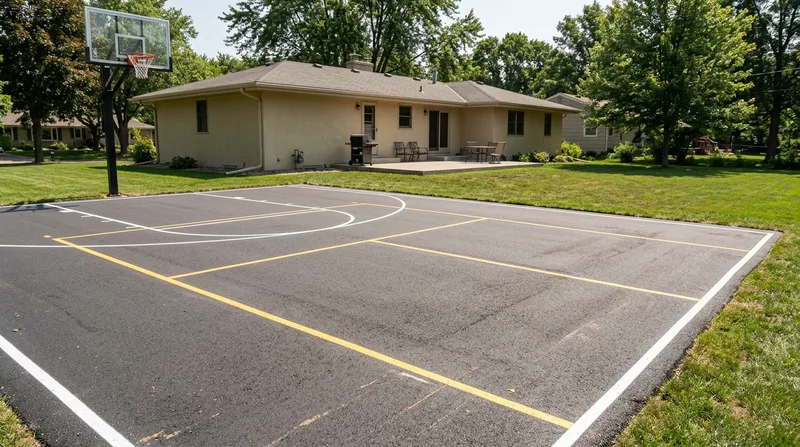




A sports court and path paving project in Minneapolis demands more than standard asphalt work. The Twin Cities sits on glacial till and clay that holds water through the long spring thaw, and a basketball or tennis court built on an unprepared base will heave and crack within a season. Minnesota's 42-inch frost line runs deeper than most of the country, and the freeze-thaw cycle that dominates March and April will tear apart any court that lacks proper aggregate base and drainage pitch. We grade and compact an aggregate base rated for Minnesota's deep frost, then pave hot mix asphalt pitched for a level, true playing surface that sheds water and holds its line through ten years of hard use. Whether you're building a backyard court in Minneapolis, St. Paul, Bloomington, or anywhere across the Twin Cities, the foundation work separates a court that plays true from one that fails.
Why Sports Court and Path Paving Matters in Minneapolis: Frost, Water, and Playing Surface
Minneapolis winters expose every weakness in a court's base. The ground freezes 42 inches deep, deeper under an uninsulated slab, and when spring arrives, the thaw is hard enough that the state posts load limits on roads until the frost is out. A court built on inadequate base will heave unevenly, creating dead spots and false bounces that ruin play and invite injury. The clay soil common across Hennepin, Ramsey, and Washington counties holds water and gives it up slowly, so without proper pitch and drainage, standing water accelerates deterioration and frost damage. A well-built court, by contrast, sheds water immediately and settles evenly as the seasons change.
- We install an aggregate base compacted in lifts and rated for Minnesota's 42-inch frost depth, not a thin screed over native soil.
- We pitch the court surface 1 to 2 percent for positive drainage, sloping away from structures and toward positive outlet.
- We use hot mix asphalt placed and finished to a true, level playing surface that meets court specifications for bounce and play.
- We compact every layer with proof rolling to verify bearing capacity and eliminate soft spots that will settle later.
A properly built court will play true and last fifteen to twenty years with routine maintenance. The cost of getting the base right is far less than replacing a court that heaved or cracked within five years.
Key info: Minneapolis and surrounding counties require Minnesota 811 utility locates before any excavation. We call 811 at no charge before beginning base work. Your municipality may also require a permit for court construction, especially if the court is an extension of impervious surface or involves grading near the property line. Check with your city building department or HOA architectural review if you live in a master-planned community.
How We Build a Sports Court in Minneapolis: Base First, Then Surface
A sports court is only as good as what's under it. We start by grading and preparing the subgrade, removing soft material and filling low spots with compacted aggregate. We then install a properly sized base course, typically four to six inches of compacted crushed stone or recycled asphalt, and proof roll it with a heavy roller to confirm it will not settle under the weight of play and equipment. Only after the base is locked in place do we pave the wearing surface. The entire process takes longer than a driveway because we cannot cut corners on foundation work.
- We call Minnesota 811 for utility locate and mark all underground lines before excavation begins.
- We grade the subgrade to remove soft clay and standing water, then compact it in lifts to eliminate future settlement.
- We install and compact aggregate base in two or more lifts, with proof rolling between each to verify bearing and density.
- We pave hot mix asphalt at the proper temperature and thickness, typically 2 to 2.5 inches for a court, and finish to a true surface.
- We pitch the court 1 to 2 percent for drainage and verify final grade with a straightedge before we leave the site.
A basketball court in Eden Prairie or a tennis court in Edina built this way will remain playable for years. Cutting the base short or skipping proof rolling guarantees failure.
Example: A homeowner in Maple Grove wanted a half-court basketball court in a backyard with poor drainage. We removed the topsoil, installed four inches of compacted recycled asphalt base, proof rolled it, then paved two inches of hot mix. The court drains immediately after rain and has remained flat and playable for three seasons. The same court built without proper base would have heaved by the second spring thaw.
For details on how we approach gravel driveway installation and grading, which uses the same base-preparation principles, see our grading guide.
Sports Court and Path Paving Methods and Materials
| Approach | Description | Best for |
|---|---|---|
| New Court Construction | Full subgrade preparation, compacted aggregate base, proof rolling, and hot mix asphalt paving to court specifications. | Backyard courts, school courts, and recreational areas built on unprepared ground or requiring deep frost-rated base. |
| Court Resurfacing | Overlay of existing court base with new hot mix asphalt, including re-pitching for drainage and surface finishing. | Courts with sound base but worn or cracked playing surface, typically after ten to fifteen years of use. |
| Walking Path and Recreational Path Paving | Graded and compacted base with hot mix asphalt finish, pitched for drainage and suitable for pedestrian and light equipment traffic. | Backyard paths, garden walkways, and light-traffic trails connecting residential properties or recreational areas. |
| Base Repair and Stabilization | Removal of failed or soft base material, replacement with compacted aggregate, and proof rolling before resurfacing. | Courts that heaved, settled unevenly, or show signs of base failure; prevents repeat failure after new asphalt is placed. |
Sports Court and Path Paving Cost in Minneapolis: What to Expect
A sports court or recreational path in Minneapolis starts at $8,500 for a small half-court or short path, but most projects run higher because the cost is driven by base preparation, not just asphalt tonnage. A full basketball court or tennis court typically runs $12,000 to $18,000 depending on site conditions, ground stability, drainage requirements, and whether the subgrade needs removal of soft material. A longer walking path with proper base runs $6,000 to $12,000 depending on length and width. The single largest variable is the condition of the ground: if the site has stable, well-draining soil and minimal excavation, costs stay lower; if the ground is clay-heavy, wet, or requires significant fill and compaction, the base work adds substantially to the bill.
Frost depth, soil conditions, and drainage all affect how much aggregate base is needed. A court built on clay in a low spot of the yard will need more base work than one on higher, drier ground. We measure the site, test soil conditions if necessary, and give you a written estimate with tonnage and thickness specified. Getting two or three estimates from local paving contractors is smart because base-preparation costs vary widely depending on how a contractor approaches grading and compaction. For a detailed breakdown of pricing across all our services, see our full pricing guide.
Sports Court and Path Paving Near Me: What Minneapolis Homeowners Should Know When Hiring
Hiring the right contractor for a sports court or path is about more than price. A court is a long-term asset, and the quality of the base work determines whether it plays true for fifteen years or fails within five. Start by asking any contractor for a written estimate that includes base thickness, aggregate tonnage, asphalt thickness, and proof-rolling procedures. A vague estimate that lists only "base and paving" without tonnage or thickness is a red flag. Ask for references from recent court or path projects in your area, and call them to ask whether the court has remained level and whether the contractor addressed drainage properly.
Check whether your municipality requires a permit for court construction. Many cities do, especially if the court adds impervious surface or involves grading near the property line. If you live in an HOA community, check the architectural review rules for material and size restrictions. Ask your contractor whether they will handle the Minnesota 811 utility locate call (we do, at no charge). Finally, verify that the contractor is fully insured and willing to provide proof of general liability coverage. In Minnesota, asphalt paving contractors are not required to hold a state license for paving work alone, so licensing is not a credential to check, but insurance is non-negotiable.
Ready to move forward? Contact us for a free estimate. We respond within 24 hours at (952) 206-5214 and will walk you through the process, permitting, and timeline for your court or path.
Sports Court & Path Paving in Minneapolis: Pricing Guide
| Service | Price | Details |
|---|---|---|
| Half-court basketball or small recreational path | Starting at $8,500 | Includes site grading, four-inch compacted base, proof rolling, and two-inch hot mix asphalt finish with proper drainage pitch |
| Full basketball court or tennis court | Starting at $12,000 | Full subgrade preparation, compacted aggregate base rated for 42-inch frost depth, proof rolling, and hot mix paving to court specifications |
| Walking path or recreational trail (per linear foot) | Starting at $45 to $65 per linear foot | Depends on width, ground conditions, and whether excavation or fill is required; typically four-inch base and two-inch asphalt |
| Base repair or failed court restoration | On estimate | Requires site inspection to assess soft material removal, fill depth, and compaction needs before cost can be determined accurately |
| Estimate and site visit | Free | We inspect the site, identify soil and drainage conditions, and provide a written estimate with tonnage and thickness within 24 hours |
Indicative pricing, the exact cost depends on square footage, finish, and site access. Free personalized estimate within 24h at (952) 206-5214.


